
Long-Term Dog Boarding in Orange County: What Actually Changes After Day Three
By The Blue Sock14 min read
- 1.The Settling Curve: Why Day Two and Three Are the Hard Ones
- 2.Appetite: The Thing That Worries Owners Most, and When It Should
- 3.Medication Over Two Weeks Is a Supply Problem, Not Just a Dosing One
- 4.Who Can Authorize a Vet Visit While You Are on a Plane
- 5.What Happens If the Sitter Cannot Finish the Stay
- 6.What Long-Term Dog Boarding Actually Costs in Orange County
- 7.Check the Cancellation Window Before You Confirm, Not After
- 8.Setting Up a Long Stay So It Holds
- 9.Frequently Asked Questions
- 10.Booking Long-Term Dog Boarding in Orange County
Long-term dog boarding in Orange County is a different problem than a weekend, and most of the advice you will find is written for the weekend.
A weekend is mostly a logistics exercise: over two or three nights, almost nothing has time to go wrong. A dog who is a little off their food on Saturday is home by Sunday night. On a ten-day stay, that same dog has time to lose weight, a medication supply has time to run out, a flight has time to get cancelled, and a sitter has time to have a family emergency of their own. Long-term dog boarding in Orange County is not a longer version of the short version — it has its own failure modes, and almost all of them are avoidable if you set the stay up knowing what they are.
This guide covers what changes past roughly day three, what to put in place before you leave, who has authority to make a medical decision while you are unreachable, and what a long stay actually costs — including the fee tiers and cancellation windows that matter far more on a two-week booking than a two-night one.
The Settling Curve: Why Day Two and Three Are the Hard Ones
Acclimation to a new environment tends to follow a rough shape, widely described in boarding and rescue settings alike. It is a tendency rather than a rule, but knowing it in advance saves a lot of unnecessary alarm from a hotel room in another time zone.
Day one is usually the easy day. Most dogs are alert, a little busy, and interested in the new house. Owners often get a reassuring first-night photo and relax.
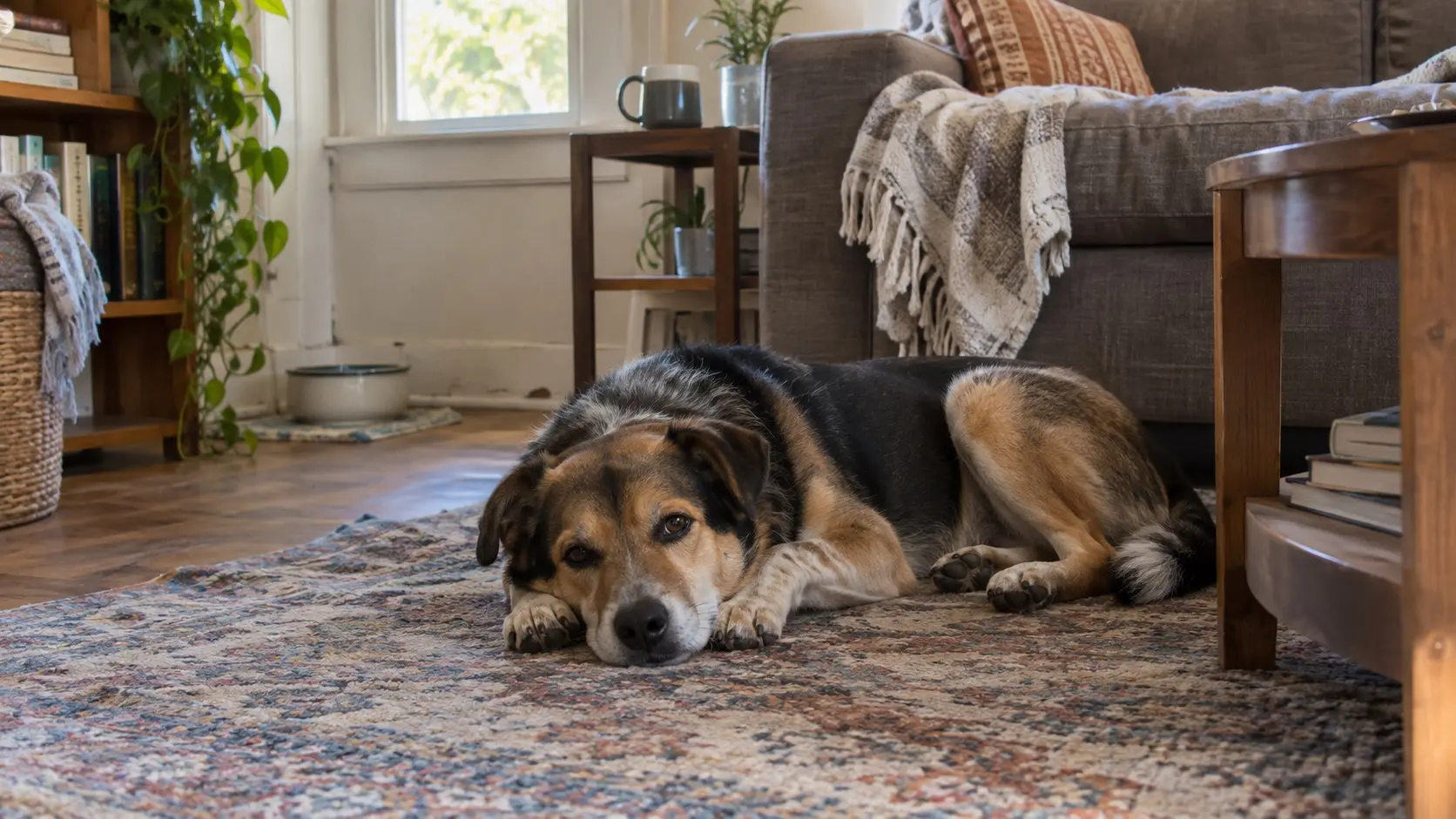
Day two and three are where it dips. The novelty has worn off and the routine has not replaced it yet. This is when appetite drops, when a dog shadows the sitter from room to room, when sleep gets restless, and when the "is my dog okay?" text usually gets sent. It is also, for most dogs, entirely normal.
Day four onward is where a long stay pays off. The dog has a spot they have chosen, a walk they recognize, and a person whose patterns they have learned. Owners who have only ever done weekend stays often never see this part — they collect their dog at the bottom of the curve rather than the top, which is one reason a short stay can leave a worse impression than a long one.
None of that is a promise about your individual dog. Anxious dogs, seniors, and dogs on their first stay away from home can run a different shape entirely, which is exactly why a meet & greet and a short trial stay before a two-week booking is worth the extra trip.
Appetite: The Thing That Worries Owners Most, and When It Should
Some reduced eating in the first 48 hours is common and usually resolves on its own. What matters on a long stay is having a threshold agreed in advance rather than improvised over text at 11 p.m.
A reasonable one to set with your sitter before you go:
- Skipped one meal, otherwise bright, drinking, normal stools — watch, no action.
- 24 hours with almost no intake, or any refusal paired with lethargy, vomiting, or diarrhea — sitter calls you, and calls a vet if you are unreachable.
- Any refusal in a diabetic dog, a puppy, a very small dog, or a dog on medication that needs food — same-day vet call regardless of how well they seem otherwise.
Two practical things help more than anything else here. Send your dog's own food, in their own container, measured — an abrupt diet change is a well-established cause of the GI upset people then attribute to stress. And send more than you think you need; a three-day buffer past your return date costs nothing and covers a delayed flight.
Medication Over Two Weeks Is a Supply Problem, Not Just a Dosing One
On a weekend, medication is a reminder. On a long stay it is inventory.
- Count the doses out loud against the stay length, including the travel days at both ends, and add a buffer. A 14-night stay with a twice-daily medication is 28 doses minimum, and a pharmacy will not refill for someone who is not you.
- Handle refills before you go. If a prescription will run out mid-stay, fill it early or arrange with your vet how the sitter can collect it — and tell the clinic the sitter's name.
- Write it down. Drug, dose, time, with or without food, what it is for, and what to do about a missed dose. Verbal instructions do not survive two weeks.
- Leave written vet authorization naming your sitter, with your clinic's number and your preferred emergency hospital. A clinic will treat an animal in an emergency regardless, but a note on file naming who may authorize care — and who is paying — removes an argument at the worst possible moment.
Independent sitters vary a great deal in what they are comfortable managing — routine oral medication is common, injections and complex regimens much less so. Ask directly, and believe a sitter who tells you your dog is not a fit; that answer is worth more than a yes.
Who Can Authorize a Vet Visit While You Are on a Plane
This is the question that decides whether someone books a long stay, and it deserves a specific answer rather than a reassuring one. Here is how it works on The Blue Sock, from the Terms of Service:
- If a pet becomes ill or injured during a stay, the sitter must make reasonable efforts to contact you immediately through the platform or the contact information you provided.
- If you cannot be reached in time and, in the sitter's reasonable judgment, the situation needs immediate attention, the sitter may transport your pet to the nearest available veterinary clinic or emergency animal hospital. By using the platform you authorize that.
- You are responsible for the veterinary costs. The platform does not pay vet bills, and neither is the sitter expected to personally.
- The sitter must notify you and the platform promptly, provide documentation of the incident, and cooperate in resolving anything arising from it.
Read point three plainly rather than around it. Whatever protection a platform offers, budget for the possibility that a vet bill lands on you, and check the specific wording anywhere you book — the terms differ between platforms and they are the part worth actually reading. What the chain above gives you is the thing that matters at 2 a.m.: a clear answer to who is allowed to act when nobody can reach you, and an obligation on the sitter to document what happened.
Before a long trip, close the remaining gap yourself: name a local emergency contact who can physically show up and make a decision, tell your sitter who that is, and leave a signed authorization with your vet. On a two-week trip across time zones, a local human with authority is the single most valuable thing on your prep list.
What Happens If the Sitter Cannot Finish the Stay
Sitters get sick, and on a fourteen-day booking the odds of something happening on their end are simply higher than on a two-night one. Booking through a platform rather than privately is mostly about this scenario.
Booking Protection covers confirmed stays booked and paid for through the platform:
- Sitter cancellation support — if a confirmed sitter cancels, the platform works to find another suitable match based on your preferences. Replacements depend on who is actually available; it is an effort, not a guarantee.
- Full refund if no replacement is found — you are not left having paid for a stay that is not happening.
- Protected payments through Stripe, with everything handled in the platform.
The catch is in the last line, and it is worth stating bluntly: payments made outside the platform are not covered. A sitter who suggests settling a long stay by Venmo to skip the fee is also, whether they mean to or not, removing your only recourse if the stay falls apart in week two. On a $1,200 booking that is a bad trade.
What Long-Term Dog Boarding Actually Costs in Orange County
Start from the county-wide bands in our Orange County dog boarding cost guide — in-home boarding generally runs $50–$85 per night, and premium or specialized care (single-guest-only homes, seniors, medication administration) $75–$120+. A fourteen-night stay therefore lands somewhere around $700 to $1,200 before extras, depending on the sitter and your dog's needs.
Three things change the arithmetic on a long booking specifically:
The service fee tier drops as the booking grows. The platform service fee is tiered by booking subtotal — 11% up to $400, 9% from $400.01 to $800, and 7% above $800, capped at $125. A single percentage applies to the whole subtotal; the tiers are not blended. In practice a long stay is charged a smaller share than a weekend, and the cap means the fee stops growing entirely past roughly $1,800.
Extended-stay discounts exist, but they are the sitter's call. Sitters may offer discounts for longer bookings, repeat bookings, or multi-pet households. Nothing obliges them to, and only one discount applies per booking — they do not stack, and the platform applies the largest one. It is a fair thing to ask about when you message a sitter about a two-week stay.
Build in the return-flight buffer. Care outside your scheduled pickup window is extended care, it is billed in the sitter's own increments, it can be charged automatically without prior approval, and past a threshold it can convert to a full overnight rate. This is not a gotcha so much as arithmetic — but on a long trip with a connection to miss, agree with your sitter in advance what happens if you land a day late, and book the pickup a little loose rather than a little tight.
Check the Cancellation Window Before You Confirm, Not After
Each sitter picks their own full-refund window from the platform's published options, and it is shown on their profile. The structure:
- 100% refund if you cancel on or before the end of the sitter's chosen full-refund window — 1, 3, or 7 days before the stay.
- 50% refund after that window, up to 11:59 p.m. the day before the stay starts.
- No refund for a cancellation on the start date.
One thing the word "100%" hides: that figure refunds the booking amount. The platform service fee is governed separately and is non-refundable except at the platform's discretion — on the $1,200 stay above, that is roughly $84 you do not get back even on a clean, inside-the-window cancellation.
On a weekend booking the difference between a 1-day and a 7-day window is small money. On a two-week booking it is the difference between getting the whole booking amount back and losing several hundred dollars — so if your travel is the kind that moves, check each profile for the window and treat it as a real selection criterion rather than fine print.
Setting Up a Long Stay So It Holds
If you are booking a week or more, especially with a sitter your dog has not stayed with before:
- Do a meet & greet, then a trial night. One overnight two or three weeks before the real stay tells you more than any profile can, and it lets your dog arrive in week one already knowing the house. Our private boarding guide covers what a good first visit looks like.
- Write one page and leave it on the counter. Routine, feeding amounts and times, medication, vet and emergency-hospital numbers, your local emergency contact, your flight details, and the two or three things that reliably calm your dog. Our pre-boarding checklist is a good starting template.
- Agree the update rhythm up front. Daily photos are common; on a long stay, what matters more is agreeing what gets escalated to a phone call. Set the appetite and behavior thresholds above before you leave.
- Keep everything in the app. Care instructions, changes, incidents, and payment. If a dispute ever comes up, undocumented conversations are the ones nobody can help you with.
- Ask what happens on day six if it is not working. A sitter who has a real answer — a decompression plan, a willingness to separate dogs, a point at which they would call you — has done this before. A sitter who has never considered it probably has not.
Frequently Asked Questions
How long is too long for a dog to board?
There is no fixed ceiling, and many dogs do well on stays of several weeks. Length matters less than continuity — one sitter for three weeks is usually easier on a dog than three sitters for one week each. The dogs who struggle with long stays tend to be those with existing separation anxiety, unmanaged medical needs, or a first-ever stay that happens to be the long one. For those, a trial stay first changes the picture more than shortening the trip does.
Will my dog forget me or regress on training over two weeks?
They will not forget you. Some regression on recently-learned cues is realistic, because a new environment and a different handler are exactly the conditions trained behavior is most fragile in. If it matters to you, say so at the meet & greet and send your cues in writing — our guide to keeping training intact during boarding covers what to hand over.
Can I extend a long stay mid-trip if my plans change?
Talk to your sitter through in-app messaging as early as you know. Extending is a continuation of the booking rather than a new one, the sitter's own extended-care rates and availability apply, and those rates are disclosed on their profile and at booking. Sitters take fewer dogs than facilities do, so availability past your original end date is not automatic — the earlier you ask, the better the answer.
Is a long stay cheaper per night than a short one?
Sometimes, but not automatically. The platform service fee is a smaller percentage on a larger booking, and some sitters offer extended-stay discounts — but discounts are each sitter's choice, only one applies per booking, and nightly rates are set individually. Compare the full quoted total for your actual dates rather than assuming a long-stay rate exists.
What if my dog and the sitter's dog stop getting along partway through?
Ask before you book how the sitter would handle it — separate spaces, staggered feeding and walks, and a willingness to call you early are the answers you want. It is also a good argument for comparing Home Environment on sitter profiles: a home with a spare room and a gated layout has options that an open-plan one does not.
Do I need anything extra for a stay of a month or more?
Plan for a grooming or nail trim mid-stay, a medication refill path, and an updated vaccination record if anything lapses during the window. Agree who pays for consumables and how, and re-check that your emergency contact will actually be in town for the whole period rather than just the first week.
Booking Long-Term Dog Boarding in Orange County
A long stay rewards the part of the search most people skip. Availability narrows fast once you are asking for two consecutive weeks, so start earlier than feels necessary — and use the extra lead time to meet two or three sitters rather than to book the first one who says yes.
Browse sitters near you on The Blue Sock, compare Home Environment and Key Skills against what your dog will need on day six rather than day one, check each sitter's cancellation window before you confirm, and message the ones who look close. For a two-week trip, an hour spent comparing now is the cheapest insurance you will buy all year.
You Might Also Like
 10 min
Jul 21, 2026
Dog Boarding in Santa Ana: What Pet Parents Need to Know
Looking for dog boarding in Santa Ana, CA? Learn why local pet parents choose in-home boarding, what to look for before you book, and how to find a sitter who fits your dog.
Read More → 11 min
Jun 6, 2026
Dog Boarding in Tustin, CA: What Pet Parents Need to Know in 2026
Looking for dog boarding in Tustin, CA? Learn why local pet parents choose in-home boarding, what to ask before you book, how pricing works, and how Tustin's proximity to Irvine widens your sitter options.
Read More → 15 min
May 16, 2026
The Ultimate Guide to Dog Boarding in Irvine, CA (2026 Edition)
Looking for dog boarding in Irvine, CA? This guide compares your three options — kennels, independent sitters, and curated Blue Sock sitters — with what to ask, how pricing works, and how to find the right fit for your dog.
Read More →